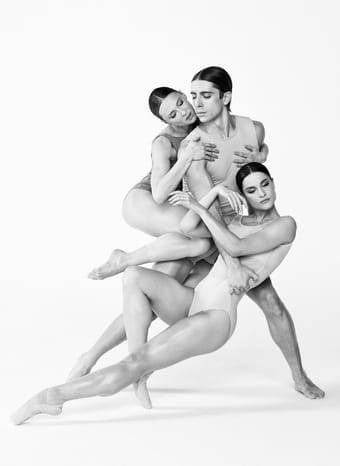
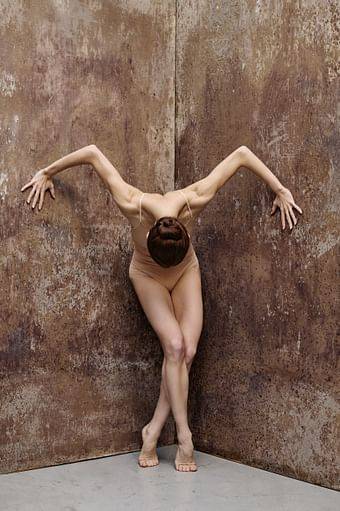
Masterpieces for Two invites the audience on a concentrated and multifaceted journey through the history of dance. In five outstanding duets the dancers explore different forms of intimacy, relationships and distance, presenting masterpieces by leading choreographers that each open their own emotional and thematic spaces.
Created in 1911 by Michel Fokine Le Spectre de la Rose tells of a young woman, in whose dream the spirit of the rose appears. To the sounds of Gustav Mahler’s Songs of a Wayfarer Maurice Béjart created an iconic duet for two dancers In Béjart’s choreography, aspects of the soul, whether they are longing, loneliness or farewell, are expressed through the bodies of the two dancers. Angelin Preljocaj’s Annonciation is one of the French choreographer’s best-known works. In this creation he not only combines religious music with electronic sounds but also reinterprets the Biblical annunciation to Mary. Variations Pour une Porte et un Soupir George Balanchine at his most experimental – inspired by Pierre Henry’s score, whose sounds imagine human sights along with the opening and closing of doors. The evening is rounded off by Jerome Robbins’ interpretation of Debussy’s Prélude à l’après-midi d’un faune. In the pared down atmosphere of a ballet studio a subtle and sensual encounter unfolds between a female and male dancer.
Leading Team
Le Spectre de la Rose
Choreografie Michel Fokine
Musik Carl Maria von Weber
Orchestrierung Hector Berlioz
Costume design Jean-Michel Lainé
Le Chant du compagnon errant
Choreografie Maurice Béjart
Musik Gustav Mahler
Kostüme und Licht Joëlle Roustan
Kostüme und Licht Roger Bernard
Annonciation
Choreografie Angelin Preljocaj
Musik Stéphane Roy
Musik Antonio Vivaldi
Costume design Nathalie Sanson
Lighting design Jacques Chatelet
Variations Pour une Porte et un Soupir
Choreografie George Balanchine
Musik Pierre Henry
Stage and costume design Rouben Ter-Arutunian
Lighting design Ronald Bates
Afternoon of a Faun
Choreografie Jerome Robbins
Musik Claude Debussy
Bühnenbild und Licht Jean Rosenthal
Costume design Irene Sharaff