The young heir to the throne, Alyosha, is deeply unhappy and lonely. On the one hand, he has withdrawn into his palace; on the other, he longs for nothing more than a person who truly understands him.
At last, he meets this “angel” who breaks through his emotional armor. But can love endure in a world shaped by constraints? In 1927, The Tsarevich premiered in Berlin. In his later work, Lehár increasingly moved closer to opera; The Tsarevich also has little in common with the dance- and jazz-influenced operettas of its time and is permeated with melancholy. Yet humor is not neglected, thanks to the comic duo Ivan and Mascha, who experience their own lively love story within the operetta.
The Dutch director and artist Steef de Jong relocates the story—originally set in Russia—into a universal fairy-tale world and focuses entirely on the slowly blossoming love story. Through beautiful and imaginative drawings and animations, filmed live and projected, as well as cardboard stage sets, an aesthetic universe emerges that combines operetta, visual art, and animated film—perfectly matching Lehár’s music and brought to life by just four singers, along with the orchestra and chorus of the Volksoper.
Leading Team
Regie, Bearbeitung, Bühne und Kostüme Steef de Jong
Lighting design Alex Brok
Choreography Wei Ken Liao
Dramaturgy Jürgen Bauer
Choir director Holger Kristen
Cast on 23. November 2026
Further dates and cast
ACT ONE
The Grand Duke secretly leads a lady through the chambers of Tsarevich Alyosha. The young heir is only interested in physical exercise and books – he strictly rejects any female presence. His aversion to women has caused a serious rift with his father, the Tsar. As they leave, the lady forgets her handbag. Ivan, the Tsarevich’s loyal valet, hides it quickly to prevent any trace of feminine presence from being discovered. Just then, his wife Mascha enters – and upon seeing the handbag, assumes her husband is having an affair. Ivan manages to calm her down and usher her out just in time before the
Tsarevich arrives.
Alyosha is lonely and conflicted. The Grand Duke presents him with portraits of potential brides, but Alyosha refuses.
He decides to go out and is driven by carriage to a small theatre on the outskirts of the city. Backstage, a young man named Kautschukoff is preparing for his performance. As Sonja, he steps onto the stage. The Tsarevich is captivated and sends an invitation for a private meeting.
Kautschukoff visits Alyosha, bringing along Sonja’s costume. The two grow closer. Alyosha confides that his father insists he find a suitable bride. Kautschukoff has a simple solution: he transforms into Sonja. The two drink, laugh, and decide to stage a performance for the court.
ACT TWO
Mascha again grows suspicious – this time, it’s a lady’s shoe left behind by Sonja. Ivan must once more pacify his jealous wife.
The Grand Duke, having heard of the affair, is delighted that the Tsarevich finally seems interested in women. Still, he cautions Alyosha not to take the relationship too seriously and to continue seeking an appropriate match. Alyosha prepares to give a speech to his regiment and dons his dress uniform.
During the speech, the Grand Duke urges Sonja to release the Tsarevich under the pretense that she was only playing with his feelings. Sonja hesitates, but under threat of being removed from court, agrees. The Grand Duke announces the imminent arrival of Princess Miliza, chosen by the Tsar as a bride for his son. Alyosha refuses to meet her.
Suddenly, Sonja bursts in with fellow performers from the theatre, hoping to lift Alyosha’s spirits.
The Grand Duke, secretly entertained, abruptly ends the charade by claiming that Sonja confessed to him that she does not truly love Aljoscha. He declares Sonja must leave the court. Shocked, Alyosha consents to marry Miliza. Kautschukoff can no longer maintain the lie. He reveals he was blackmailed by the Grand Duke. At last, Alyosha declares his love for Kautschukoff – and Kautschukoff returns his feelings.
ACT THREE
Alyosha and Kautschukoff have fled to Italy, where they enjoy a life of freedom and love.
Ivan and Mascha have followed – and both begin flirtations of their own: Ivan with Lina, Mascha with Bordolo. When these affairs are discovered, a heated argument breaks out. But their Italian companions show them that love need not be taken so seriously.
The Grand Duke tracks down the runaway couple. He pleads with Kautschukoff to end the relationship – under current circumstances, there can be no future for the two. Kautschukoff sees the painful truth.
Finally, the Grand Duke delivers the news: the Tsar is dead. Alyosha must return and assume his role as emperor – and he obeys.
Photos and Videos
For all those who use a screen reader, a description of the visual aspects of the performance (set design, costumes...) follows here instead of the photo gallery.
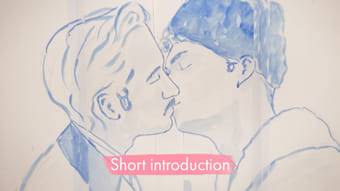
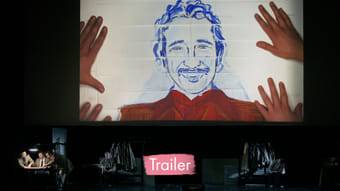
For the production of *The Tsarevich*, director Steef de Jong drew and painted hundreds of individual illustrations that can also be animated. This means that drawn characters can move their arms and legs, birds can fly by moving the paper, eyes can open and close, and much more. These drawings tell the story; they are animated live on a table on the left side of the stage and projected onto a giant screen. This creates a kind of live-action animated film that tells the story. Below the screen is a narrow strip of stage that resembles a studio. Here, on the left is the drawing table, on the right a table for sound effects, and against the back wall, coat racks and chairs. Four singers perform all the roles, sing, make sounds, and thus bring the animated film to life. They wear work coats and look like studio staff. Some scenes are acted out on the small stage rather than drawn, particularly those involving the comical couple Ivan and Masha. For these, there are simple backdrops made of painted cardboard pieces, such as doors or a garden set. The costumes also look as if they were painted.
---Kopie.JPG "© Barbara Pálffy / Volksoper Wien")
---Kopie.JPG "© Barbara Pálffy / Volksoper Wien")
---Kopie.JPG "© Barbara Pálffy / Volksoper Wien")
---Kopie.JPG "© Barbara Pálffy / Volksoper Wien")
---Kopie.JPG "© Barbara Pálffy / Volksoper Wien")
.JPG "© Barbara Pálffy / Volksoper Wien")
.JPG "© Barbara Pálffy / Volksoper Wien")
.JPG "© Barbara Pálffy / Volksoper Wien")
.JPG "© Barbara Pálffy / Volksoper Wien")
.JPG "© Barbara Pálffy / Volksoper Wien")
.JPG "© Barbara Pálffy / Volksoper Wien")
.JPG "© Barbara Pálffy / Volksoper Wien")
.JPG "© Barbara Pálffy / Volksoper Wien")
.JPG "© Barbara Pálffy / Volksoper Wien")
.JPG "© Barbara Pálffy / Volksoper Wien")
.JPG "© Barbara Pálffy / Volksoper Wien")
.JPG "© Barbara Pálffy / Volksoper Wien")
.JPG "© Barbara Pálffy / Volksoper Wien")
.JPG "© Barbara Pálffy / Volksoper Wien")
.JPG "© Barbara Pálffy / Volksoper Wien")
.JPG "© Barbara Pálffy / Volksoper Wien")
.JPG "© Barbara Pálffy / Volksoper Wien")
.JPG "© Barbara Pálffy / Volksoper Wien")
.JPG "© Barbara Pálffy / Volksoper Wien")
.JPG "© Barbara Pálffy / Volksoper Wien")
Articles from our Weborello
“Unanimous applause”, “Audience success”, “Lehár just like in a picture book”: press reviews of Der Zarewitsch
There were standing ovations and prolonged applause for everyone involved at the premiere of Lehárs operetta Der Zarewitsch. The press is also enthusiastic.
.JPG "Martin Enenkel (Iwan), Steef de Jong (Regie, Bearbeitung, Bühne und Kostüme), Juliette Khalil (Mascha), David Kerber (Der Zarewitsch), Hedwig Ritter (Sonja / Kautschukoff) - © Barbara Pálffy / Volksoper Wien")
5 reasons you shouldn’t miss Der Zarewitsch
On April 13, 2026, Der Zarewitsch will celebrate its premiere – at last, this central work of the operetta repertoire returns to the program. We have put together 5 good reasons why you should not miss this performance under any circumstances!

Shared storytelling full of imagination
On April 13, 2026, the operetta Der Zarewitsch (The Tsarevich) premieres in a way you’ve never seen before. We spoke with director Steef de Jong about Tsarevich auditions, operetta stereotypes, and the love of storytelling.

Press comments
The audience is highly satisfied and cheers especially for de Jong. Operetta can indeed be presented in a different way—Léhar’s music has not suffered in the process.
Orpheus Opera Magazine
17. April 2026
With the engagement of Steef de Jong, Lotte de Beer has landed a real coup. The 42-year-old all-round artist succeeds in creating a touching, completely unconventional, and simply delightful interpretation of this rarely performed work.
APA
14. April 2026
Unanimous acclaim
Die Presse
14. April 2026
Perhaps operetta—the once-troubled, seemingly outdated child of musical theatre—can indeed be saved, if only an excess of diligence and love is invested? Anyone who suspects as much is likely to feel confirmed by the new Zarewitsch at the Volksoper: here we have Lehár as if straight out of a picture book—in the truest sense of the word.
Kurier
14. April 2026
Euphoric applause for all
Der Standard
15. April 2026
An open heart and a childlike gaze are enough to fall in love with de Jong’s paper mechanics and, within them, to rediscover theatre itself—or at least a form of it. One may or may not like de Jong’s visual style, but it is certain that with his means he demonstrates more craftsmanship than can be found in various other new productions.
Die Presse
14. April 2026
Franz Lehár’s operetta becomes a crowd-pleaser at the Vienna Volksoper in a charming guise.
Der Standard
15. April 2026
This overall concept (…) is so unique and lovingly crafted that the rigid rules some like to impose on musical theatre are airily suspended: such a degree of joyful seriousness applied to an operetta is rarely seen. Those who value feeling in this genre more than form will find themselves enchantingly rewarded here.
Kurier
14. May 2026


.jpg "Anett Fritsch (Mimì), Giorgio Berrugi (Rodolfo)")

.jpg "Hedwig Ritter (Adele)")