Text by Karl Haffner and Richard Genée
Pride Edition text version by Jürgen Bauer and Moritz Franz Beichl
In German language with German and English surtitles
Every year in June, Pride Month celebrates the visibility of queer culture, but also commemorates the fight against marginalisation and discrimination. Pride is resistance and joie de vivre! And what work would be better suited to take a fresh look at eroticism, love and social expectations on the occasion of this festival than Johann Strauss' Die Fledermaus?
Operetta of all things? Yes - no genre is more queer! Subversive and revealing from the very beginning, it has always been a play with gender roles and desires. With masquerade and transformation, it tells of people who take on - or have to take on - other identities. What changes when relationships are not automatically heterosexual? When social norms produce not just pleasurable deceptions, but existential lies?
Jürgen Bauer and Moritz Franz Beichl have written a new version of the text for this pillar of the repertoire. No matter how you love or define yourself - celebrate Pride Month with us, the operetta and the liberating laughter about the masks that society wants to impose on us.
For all those who use a screen reader, a description of the visual aspects of the performance (set design, costumes...) follows here instead of the photo gallery.
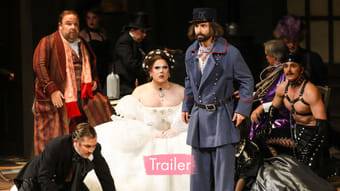
The Pride version of the operetta is set against a historical backdrop that roughly corresponds to the time the play was written, in the late 19th century. In the first act, the Eisenstein family’s home—a classic Viennese living room—is furnished with meticulous attention to detail, complete with furniture and textiles. In the second act: Prince Orlofsky’s chambers, where an opulent celebration is taking place. The third act takes place in a prison, with an entrance to the cells on the left and a desk in the center. The sets are all rich in detail and furnished with numerous props and pieces of furniture, creating spaces that appear realistic. The costumes in the Pride version of *Die Fledermaus* are opulent and draw on queer role models. In the second act, for example, the character Ida appears in a massive costume as Empress Sisi, while Orlofsky wears a feathered dress with a coat and a mustache, thereby blurring gender boundaries. Ivan wears black leather pants and a leather harness. Rosalinde, on the other hand, arrives at the ball dressed as a man in a tailcoat and a black fur coat. The ballet dancers wear skin-tight black-and-white leotards and opulent headdresses. The costumes are mostly black and purple, with a few other color accents. The impression created is that of a queer ball, where the costumes are opulent, playful, and sexy.
Additional performance of “Die Fledermaus – Pride Edition” on June 21st.
Due to the tremendous success and high demand, we are pleased to offer an additional performance of Die Fledermaus – Pride Edition on Sunday, June 21, 2026, at 7:00 p.m.
The Volksoper can be proud of its Die Fledermaus Pride Edition: this successful queer adaptation of the operetta classic, featuring Conchita/Tom Neuwirth as Frosch, brought the packed house to its feet.
Die Presse10. June 2026
The evening becomes a triumph for the entire ensemble, with Neuwirth providing exactly the right spark.
ORF10. June 2026
Never before has this operetta classic been so colorful: a humorous and biting exploration of love, identity, and social norms. (5 out of 5 stars)
Kronen Zeitung10. June 2026
In terms of sheer event value, Tuesday evening at Vienna’s Volksoper may have delivered the operatic highlight of the year so far. The Die Fledermaus Pride Edition with Tom Neuwirth as Frosch (...) demonstrated how, by making only a few adjustments, a beloved entertainment classic can be transformed into a revelatory piece of theatre.
ORF10. June 2026
At the Volksoper, the Pride Edition of Strauss’s operetta becomes a coherent Gesamtkunstwerk.
Der Standard11. June 2026
Operetta has never been an exclusively heterosexual affair. The queer twist that Jürgen Bauer and Moritz Franz Beichl give Strauss’s Die Fledermaus libretto for this Pride edition therefore fits seamlessly.
.JPG "© Barbara Pálffy/Volksoper Wien")
.JPG "© Barbara Pálffy/Volksoper Wien")
.JPG "© Barbara Pálffy/Volksoper Wien")
.JPG "© Barbara Pálffy/Volksoper Wien")
.JPG "© Barbara Pálffy/Volksoper Wien")
.JPG "© Barbara Pálffy/Volksoper Wien")
.JPG "© Barbara Pálffy/Volksoper Wien")
.JPG "© Barbara Pálffy/Volksoper Wien")
.JPG "© Barbara Pálffy/Volksoper Wien")
.JPG "© Barbara Pálffy/Volksoper Wien")
.JPG "© Barbara Pálffy/Volksoper Wien")
.JPG "© Barbara Pálffy/Volksoper Wien")
.JPG "© Barbara Pálffy/Volksoper Wien")
.JPG "© Barbara Pálffy/Volksoper Wien")
.JPG "© Barbara Pálffy/Volksoper Wien")
.JPG "© Barbara Pálffy/Volksoper Wien")
.JPG "© Barbara Pálffy/Volksoper Wien")
.JPG "© Barbara Pálffy/Volksoper Wien")
.JPG "© Barbara Pálffy/Volksoper Wien")
.JPG "Daniel Schmutzhard (Gabriel von Eisenstein), Thomas Oliemans (Dr. Falke), Martin Winkler (Frank), Tom Neuwirth (Frosch), Katia Ledoux (Prinz Orlofsky), Chor der Volksoper Wien - © Barbara Pálffy/Volksoper Wien")
.jpg "Hedwig Ritter (Adele)")