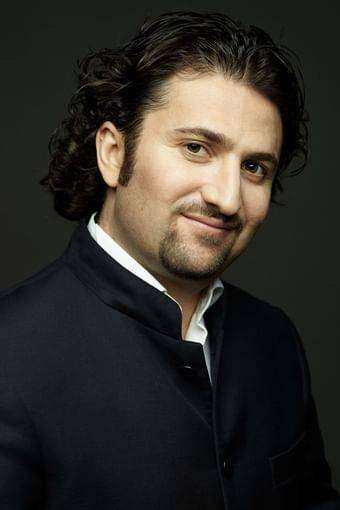
Mikhail Agrest
When were you first enchanted by musical theatre? And how?
My first experience was a performance of The Nutcracker at the Kirov/Mariinsky Theatre when I was about 7 or 8 years old, followed by my discovery of the world of Tchaikovsky's operas. At that time, especially when we emigrated from the USSR – which at that time meant never returning (with our first stop in Vienna) – I could not have imagined that some 20 years later I would be standing in the orchestra pit of the Mariinsky Theatre conducting Tchaikovsky's operas and ballets.
Why do people sing, and why don't they speak?
Singing adds a profound dimension to language, enabling the conveyance of emotions and nuances that words alone cannot capture. It goes beyond mere communication and reaches the depths of our hearts and souls on a subconscious, artistic level. Through melody, harmony, rhythm and orchestration, singing reinforces the message, expresses the unspoken and evokes a deeper, more intense connection to the lyrics.
What role can/should musical theatre play in our society?
Musical theatre plays an important role in society by reflecting social issues, promoting empathy and bringing people together through shared emotional experiences. It preserves and reshapes cultural identity, provides joy and escape, and stimulates creativity and dialogue in communities. Ultimately, it not only entertains, but also inspires social awareness and human connection.
***
Born in
St. Petersburg (Russia)
Education
Violin at Indiana University Bloomington, USA, with Josef Gingold
Conducting at the Rimsky-Korsakov St. Petersburg State Conservatory with Ilya Musin and Mariss Jansons
2000 & 2001: American Academy of Conducting (Aspen Music Festival)
Important Engagements
- Mariinsky Theatre (2001–2014)
- BBC Gubaidulina Weekend Barbican, London with the BBC Symphony Orchestra and Choir
- Metropolitan Opera in New York (2003) with the Mariinsky Theatre Orchestra (The Legend of the Invisible City of Kitezh and the Maiden Fevroniya)
- Jaromir Weinberger Opera Svanda Dudak at Semperoper Dresden and Teatro Massimo Palermo
- Jenufa, English National Opera (won the Olivier Award for Opera of the Year)
- Stravinsky: Le Rossignol (opera), Le Noces (ballet cantata), Le Sacre du Printemps in one evening at the Mariinsky Theatre
- Operas at the Semperoper Dresden, the Staatsoper Hannover, the Badisches Staatstheater, Opera Australia, the Finnish National Opera, the Royal Opera Stockholm, the Oper Graz.
- 2020-2025 Music Director of the Stuttgart Ballet
- Singapore Symphony Orchestra, National Symphony Orchestra of China, National Symphony Orchestra (Taiwan), London Philharmonic Orchestra, BBC Philharmonic Orchestra, Dresden Philharmonic Orchestra, Bremen Philharmonic Orchestra, Seattle Symphony, Orchestre Philharmonique de Radio France
- Bavarian State Ballet, Paris Opera Ballet, New York City Ballet, Royal Ballet Covent Garden, Zurich Ballet.
Formative collaboration with these artists
David Alden, Jonathan Miller, John Neumeier, Alexey Ratmansky, Rodion Shchedrin, Sofia Gubaidulina, Anna Netrebko, Olga Borodina, Amanda Roocroft, Elena Stikhina, Olga Peretyatko Vladimir Sulimsky, Vladimir Galuzine, Pierre- Laurent Aimard, Diana Vishneva, Uliana Lopatkina, Valentina Collasante, Mathieu Ganio
Debut at Volksoper Wien
2025/26: Musical Director Peter Pan
Important prizes and awards
2nd prize, Antonio Pedrotti International Conducting Competition 2001, Italy
3rd prize, Dimitri Mitropoulos International Conducting Competition 2002, Greece
Website
https://www.mikhail-agrest.com/
* Use of the photograph (© Daniil Rabovsky) solely for the purpose of current reporting on the Vienna Volksoper.